

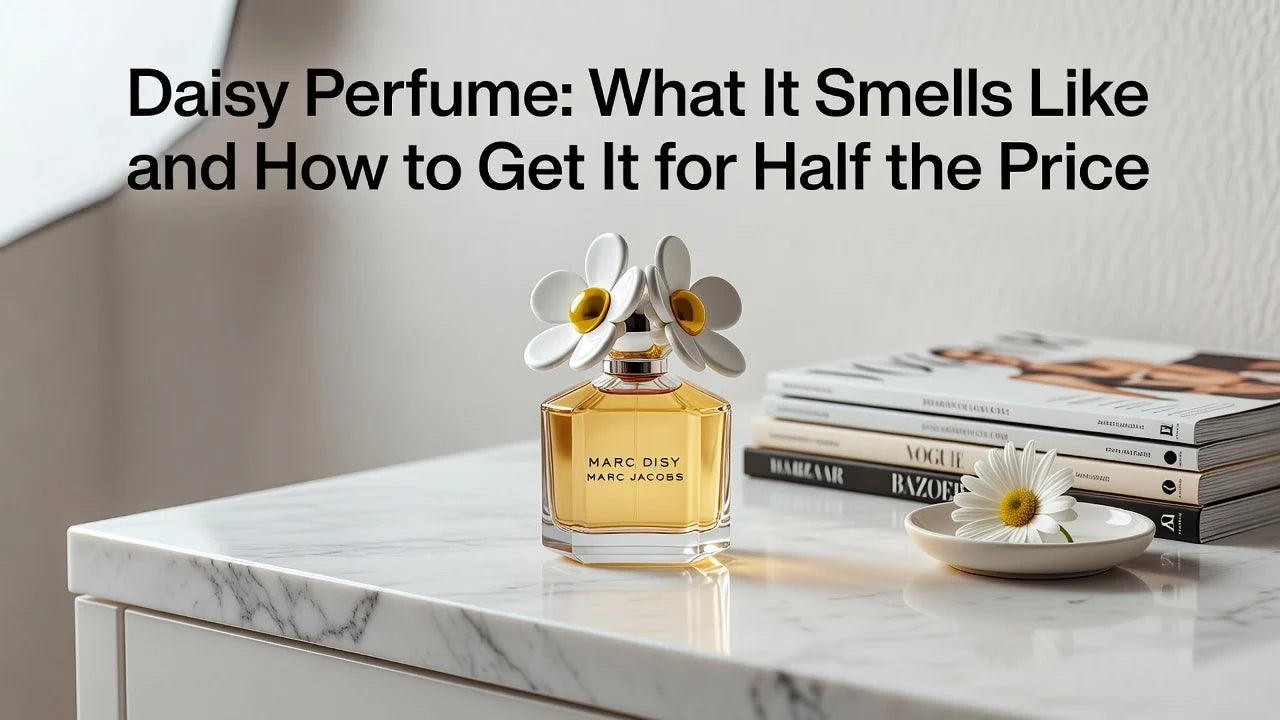
If you have ever walked past a perfume counter and spotted that adorable white bottle with the little daisy cap, you already know how charming Marc Jacobs Daisy perfume looks. But does it smell as good as it looks? Spoiler: yes, it absolutely does, and it has become one of the most beloved fragrances in the world for good reason.
Whether you are totally new to perfume or just curious about what all the fuss is around daisy perfume, you are in the right place. In this post, we are going to break down exactly what Daisy smells like, who it is best suited for, and when to wear it. But here is the really exciting part: we are also going to show you some incredible alternatives that capture the same fresh, flirty vibe for a fraction of the cost.
Because honestly, smelling amazing should not require emptying your wallet. By the end of this post, you will know everything you need to find your perfect match, whether that is the original or a budget-friendly dupe that works just as well.
What Does Daisy Perfume Actually Smell Like?
If you've ever wondered why daisy perfume has such a devoted following, it all comes down to how beautifully the scent is built from the ground up. The fragrance opens with a burst of bright, fresh top notes: wild strawberry, violet leaves, and ruby red grapefruit. This initial combination feels both fruity and faintly tart, hitting your senses with that clean, joyful energy that makes it so instantly recognisable. It's the kind of opening that feels like sunshine in a bottle, which is exactly why it resonates so strongly with younger wearers looking for an everyday signature scent.
Once those top notes settle, the real heart of the fragrance reveals itself. Soft violet petals, gardenia, and jasmine come together to create a delicate floral warmth that manages to feel feminine without ever tipping into heavy or old-fashioned territory. This is the part of the scent that fragrance experts at House of Moksha describe as "airy and light," evoking sun-drenched meadows in full bloom. It's romantic without being overpowering, which makes it genuinely versatile across different occasions and seasons.
The base notes are where longevity lives. A gentle blend of vanilla, white woods, and musk gives the fragrance its staying power, leaving a subtle, skin-like warmth that lingers beautifully through the day. This dry-down is what transforms daisy from a pretty opening into a truly memorable wear.
Floral fragrances like this one consistently dominate women's fragrance sales globally, particularly among younger consumers, and it's easy to understand why. The female perfume market is forecast to grow at a CAGR of 4.5% through to 2033, with fresh-floral profiles sitting right at the heart of that growth.
Understanding these three layers, top, heart, and base, is genuinely useful when you're shopping for an inspired alternative. A quality dupe should replicate all three, not just mimic the opening spray. That's the difference between a fragrance that truly captures the daisy spirit and one that simply smells similar for the first five minutes.
Why Marc Jacobs Daisy Became a Generation's Signature Scent
When Marc Jacobs Daisy launched in 2007, it did something genuinely rare: it created a fragrance that felt like a mood rather than just a scent. Described by its creators as "the coming-of-age fragrance," Daisy captured something specific and hard to bottle, quite literally. It felt young, optimistic, and effortlessly free, without trying too hard. That emotional clarity is a huge part of why it resonated so deeply with Millennial consumers first, and has since crossed over to become a genuine gateway scent for Gen Z shoppers discovering florals for the first time.
The iconic daisy-topped bottle played its part too. In an era where fragrance is as much about the shelf aesthetic and the flat-lay photo as it is about the smell, Daisy's packaging became its own kind of shorthand. The enduring appeal of Marc Jacobs Daisy has been well-documented, with the hashtag racking up millions of TikTok views and the #daisy aesthetic functioning as visual code for light, spring-ready femininity across Instagram and beyond. Social media didn't create Daisy's popularity, but it absolutely amplified it into something generational.
Part of what makes Daisy so aspirational is the brand sitting behind it. Marc Jacobs occupies the same prestige tier as Chanel, Dior, and Estée Lauder, and that brand halo gives Daisy a sense of luxury that goes beyond the liquid in the bottle. You can explore the full Marc Jacobs fragrance range to see how deliberately the house has built on that identity over the years.
Here is the interesting thing though: when people fall in love with the daisy perfume style, what they are really falling for is the scent itself, the fresh florals, the light and wearable character. The logo matters for gifting and aspiration, but the fragrance profile is what keeps people reaching for it every morning.
The Price Tag Problem Nobody Talks About Honestly
Let's have an honest conversation about something the beauty industry rarely addresses directly. Marc Jacobs Daisy retails in the UK at around £60 for 50ml and anywhere from £90 to over £100 for 100ml. That places it squarely in the premium fragrance tier, which accounts for approximately 45% of global perfume sales. It is a beautiful, well-crafted scent, and that popularity is completely deserved. But the price creates a genuine access problem that deserves to be named plainly.
For students and young professionals, spending £80 or more on a single bottle of perfume is a serious financial decision, not a casual purchase. This is not a niche concern either. Global fragrance trend data for 2026 consistently highlights affordability and value as increasingly dominant purchase drivers, with budget-conscious shoppers actively seeking alternatives rather than simply going without. When OK! Magazine UK ran a story treating a 50% discount on Daisy as headline news, that reaction told its own story about where the standard price sits for most people.
Here is something worth understanding. That premium price tag does not exclusively reflect what is in the bottle. It also covers luxury packaging, brand marketing budgets, retailer margins, and the cultural weight of the label itself. As Glossy reported on the Daisy fragrance empire, the iconic bottle design and brand identity are central to the product's commercial power, and that visual prestige carries a cost that the consumer ultimately absorbs.
This is not criticism of the fragrance itself. It is simply an honest acknowledgement that the price creates a real gap between loving a scent and actually owning it. The rapid growth of the designer-inspired fragrance segment in 2026 is a direct market response to exactly that gap, offering the same olfactory experience at a fraction of the cost.
Marc Jacobs Daisy vs. an Affordable Daisy-Inspired EDP: A Honest Comparison
So you've read about the scent, the cultural legacy, and the price reality. Now let's put both options side by side in plain terms, so you can make an informed choice without any fluff.
Scent Profile: Does the Inspired Version Actually Smell the Same?
This is the question that matters most, and it deserves a straight answer. The fresh violet-strawberry-jasmine-vanilla arc that makes Daisy so recognisable is a specific construction, not just a vague "floral" direction. Aromaavenue's daisy-inspired EDP is formulated to follow that same scent journey closely, using quality ingredients rather than cheap synthetic shortcuts that flatten the fragrance into something generic. The result is an opening that feels bright and fresh, a floral heart that carries the same feminine softness, and a warm, slightly sweet dry-down that mirrors the original's character. Consumer experience across the inspired fragrance category backs this up consistently; as one shopper put it when comparing a Daisy-inspired scent to the original, it was "spot on the same fragrance". Skin chemistry will always play a small role in how any fragrance develops on your body, so individual results can vary slightly, but the core profile holds.
Concentration: Why EDP Matters More Than You Think
Both Marc Jacobs Daisy and Aromaavenue's alternative are Eau de Parfum formulations, and this is worth understanding properly. EDP sits at roughly 15 to 20% fragrance oil concentration, which places it above Eau de Toilette and well above body mists or cologne. In practical terms, this means the scent is richer, more present on skin, and built to last. The global fragrance market is actively seeing consumers trade up to EDP and Parfum concentrations because they deliver better performance, and this trend confirms that EDP has become the recognised standard for everyday wear that actually lasts. Choosing an affordable EDP over a pricier one does not mean stepping down in concentration; you are working at the same tier.
Longevity: Dispelling the Cheap Equals Short-Lived Myth
The assumption that a lower price means a fragrance fades within an hour simply does not hold when both options share the same concentration class. As an EDP, both versions are designed to last 6 to 8 hours on skin, which covers a full working day or an evening out comfortably. The dupe movement has gone from niche to mainstream, and part of what is driving that shift is real-world performance; affordable alternatives are regularly praised for longevity that surprises first-time buyers.
Price: The Numbers Speak for Themselves
Marc Jacobs Daisy 50ml retails at around £60 in the UK. Aromaavenue's daisy-inspired 50ml starts at £24.95, with the 100ml version available from £29.95. That is a saving of between £35 and £70 depending on which bottle size you compare. For students, daily wearers, or anyone building a fragrance wardrobe rather than collecting a single bottle, that difference is genuinely significant.
Bottle and Packaging: The One Real Trade-Off
Let's be honest about where the original does win. The Marc Jacobs Daisy bottle, with its iconic daisy-cap design, is part of what you are paying for. It is collectible, instantly recognisable, and has real shelf presence. That aesthetic has contributed heavily to the fragrance's cultural staying power, including over 5 million TikTok views for the hashtag alone. Aromaavenue's packaging is clean and elegant, but it does not replicate that premium unboxing experience. For most everyday wearers, this is a perfectly fair trade-off; the scent is what you actually wear, after all.
Will a Daisy-Inspired Perfume Actually Last All Day?
Here's something that surprises a lot of first-time fragrance buyers: how long a perfume lasts on your skin has almost nothing to do with the brand name on the bottle. It comes down to one thing, concentration. An Eau de Parfum contains a higher percentage of fragrance oil than an Eau de Toilette, and that single difference is what determines whether your scent is still there at 9pm or faded by lunchtime.
This matters a lot in the daisy fragrance world. The original Marc Jacobs Daisy is an EDT, which sits at a lighter concentration. A well-formulated daisy-inspired EDP, on the other hand, carries more fragrance oil per ml by definition. That means the chemistry is working in your favour from the moment you spray.
A good-quality EDP, from any price point, typically delivers around 6 to 8 hours of wear. The top notes (your bright citrus and fresh florals) will bloom and fade within the first hour or two, but the base notes, particularly musk and soft woods, are the real marathon runners. They cling to warm skin and continue to project well into the evening, which is exactly what you want from an everyday floral.
It's worth noting that shoppers in 2026 are catching on to this. According to expert fragrance guidance published this year, EDP is consistently recommended over EDT for longer wear, and the format is gaining market share as consumers connect higher concentration with better value per spray.
Application technique gives you an extra edge too. Spraying onto pulse points like your wrists, neck, and behind the knees means the fragrance interacts with your body heat throughout the day. Applying to moisturised skin also helps, as hydrated skin holds scent noticeably longer than dry skin.
The practical takeaway? If you are currently wearing a daisy-style EDT and switching to a designer-inspired EDP, you may find the inspired version actually outlasts what you were wearing before. For many first-time buyers, that is a genuinely pleasant surprise.
When and How to Wear a Daisy-Style Fragrance
Daisy-style fragrances are, at heart, spring and summer scents. The bright citrus and violet top notes feel completely at home in warm weather, where fresh florals can breathe and bloom naturally on the skin. That said, the soft musky base gives this fragrance style more versatility than people often expect. In cooler months, layering a daisy-style scent over a slightly warmer base, such as a vanilla body lotion or a muskier moisturiser, can carry it comfortably into autumn and early winter without it feeling out of place.
For daytime wear, this fragrance profile is genuinely hard to beat. The light, clean sillage means it sits close to the skin without filling a room, which makes it ideal for university lectures, office environments, coffee shop catch-ups, and weekend brunches. Nobody around you will be overwhelmed, but you'll still smell quietly brilliant. That balance is actually quite rare in the floral category, and it's a big part of why this scent style has such lasting appeal among younger women especially.
Evenings are a slightly different story. The trick is to apply a little more generously and prep your skin first with an unscented body lotion. Moisturised skin holds fragrance longer, and the lotion base helps the warmer vanilla and musk notes in the dry-down project more fully. The result shifts the scent from fresh-and-light to soft-and-warm without needing a completely different bottle. This layering technique has moved well beyond niche fragrance circles, with communities dedicated to scent layering now numbering in the millions online.
As a gift, daisy-style fragrances sit in a genuinely safe spot. The freshness is broadly appealing, the floral character is never divisive, and the overall impression is clean and considered. For birthdays, graduations, or Christmas, it's the kind of choice that lands well with almost anyone. At the £24.95 to £29.95 price point, it also feels like a genuinely generous gift without putting pressure on your budget, which makes the decision even easier.
Who Actually Buys a Daisy-Inspired Perfume?
The honest answer is: a lot more people than you might think, and they all have something in common. They want the fragrance experience without paying a premium that mostly covers brand packaging and retail margin.
Students are probably the most obvious fit. Gen Z spends an average of £160 per year on fragrance, which sounds impressive until you realise that budget has to stretch across a whole year of wanting to smell great every day. A single bottle of Marc Jacobs Daisy at £60 or more would swallow almost half that budget in one go. A daisy-inspired EDP at £29.95 for 100ml solves the problem completely, leaving room to actually wear it freely rather than rationing every spray.
Young professionals are the next natural buyer. They want a polished, grown-up floral that works in an office environment, but they are also the generation most likely to question whether a brand name justifies a price gap. Getting a full 100ml EDP for roughly what a week of coffee-shop visits costs is exactly the kind of smart trade-off this group makes instinctively.
Smart shoppers who have actually tried the original and simply concluded the scent quality does not gap the price gap are a rapidly growing group, backed by real market data showing affordable fragrance alternatives are now mainstream rather than a niche workaround.
Gift buyers will also find this a genuinely strong option. Floral daisy-family scents are widely considered universally pleasing and feel considered as a gift, and presenting something in a 100ml EDP format reads luxurious regardless of what it cost.
Finally, Gen Z and Millennial consumers are the primary growth drivers for fragrance discovery in 2026, and they have grown up in a culture that rewards smart consumption. With 83% of Gen Z wearing fragrance regularly and most owning between 8 and 12 scents simultaneously, accessible price points are not a compromise; they are the whole point.
The Verdict: Same Scent, Smarter Price
Here is the bottom line, and it is a simple one. The scent profile of daisy perfume is what you are actually buying, and that profile does not come with a brand tax attached. You do not need to spend £60 to £100 to wear fresh violet, soft florals, and warm vanilla on your skin every single day.
Aromaavenue's daisy-inspired EDP delivers that same note journey, from the bright violet-strawberry opening through the soft white floral heart, right down to the warm vanilla and musk finish, in a full-size bottle starting at £24.95 for 50ml and £29.95 for 100ml. Because it is formulated as an Eau de Parfum, the concentration matches the original, which means you get the same staying power and sillage without compromise. That makes this a genuinely like-for-like comparison on everything that matters for everyday wear.
The smart move is to make the inspired version your daily signature, save the difference, and if you ever choose to invest in the designer original for a special occasion, you will do it as an informed buyer rather than an impulse one.
Browse Aromaavenue's daisy-inspired fragrance range at Aromaavenue.uk and find your affordable daisy fragrance today.
Conclusion
Daisy perfume is a timeless, feel-good fragrance that deserves every bit of its legendary status. It smells fresh, flirty, and effortlessly feminine, making it perfect for everyday wear and warm-weather moments. The good news is that you do not have to pay full price to enjoy that signature vibe. High-quality dupes and alternatives can deliver a nearly identical experience for a fraction of the cost.
Here is what to take away: Daisy is a classic worth knowing, budget alternatives are absolutely worth exploring, and smelling incredible should always be accessible to everyone.
Ready to find your perfect scent? Browse the alternatives we highlighted, order a sample or two, and discover which version makes you feel your best. Your signature fragrance is out there waiting, and it does not have to cost a fortune to find it.


Leave a comment
This site is protected by hCaptcha and the hCaptcha Privacy Policy and Terms of Service apply.