

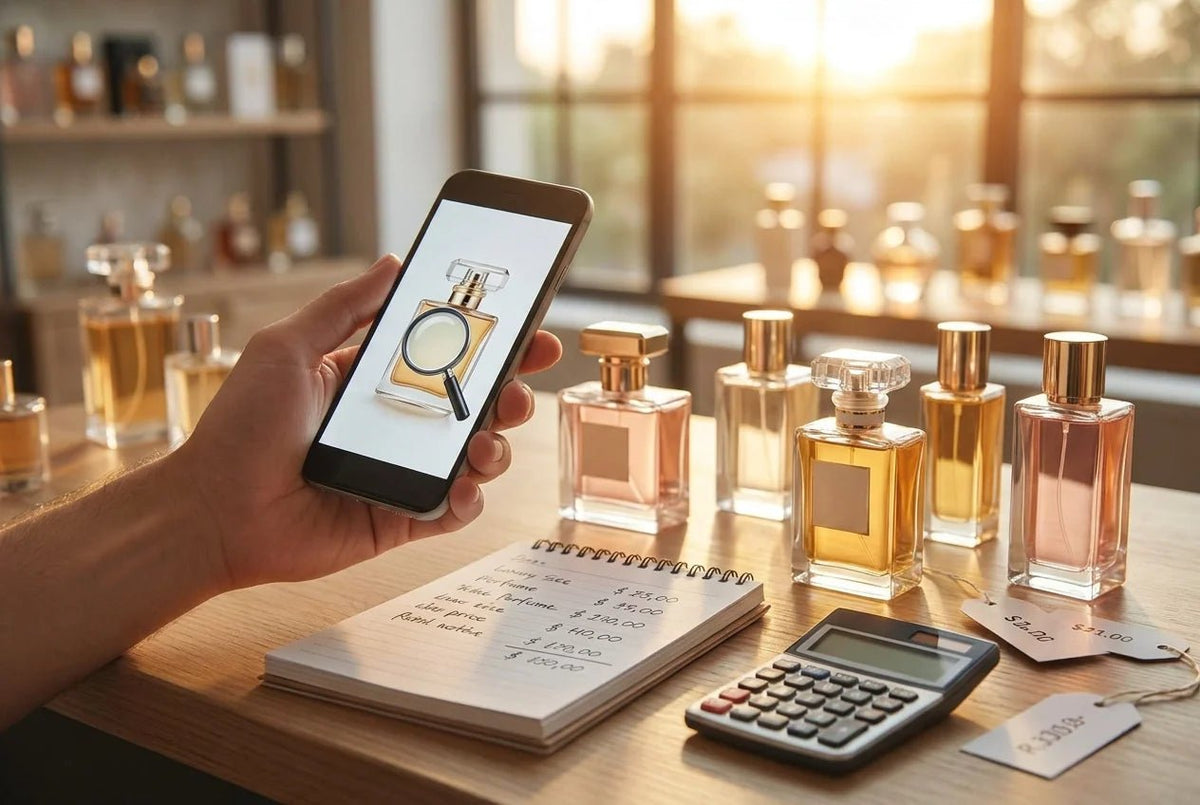
Black Friday perfume deals can look irresistible. A glossy 50% off badge, a countdown clock, and a "was" price that makes your favourite scent feel like a once-a-year steal. But here is the catch: many fragrance savings are calculated against a price nobody actually paid. That does not always mean the deal is fake, but it does mean you need a quick way to check it.
This guide to black friday perfume deals is not a round-up of deals to click. It is a one-minute audit you can run before you spend. We will look at why most Black Friday perfume deals are built on shaky reference prices, then cover three things to have open before you start. You will learn the duration test, the volume test, and the difference between RRP, previous price, and future price. We will also do bundle maths for true cost per millilitre, question countdown clocks, urgency claims, and stock dumping, use a one-minute checklist, see where designer-inspired pricing fits in, and run the audit before you check out.
Why Most Black Friday Perfume Deals Are Calculated Against a Price Nobody Paid
Every Black Friday perfume deal rests on a reference price: the "was" figure the discount is measured against, and the anchor that makes a saving feel real before you have checked anything. Often, that anchor is fiction. Across periods sampled in 2021 to 2023, the Competition and Markets Authority (CMA) found four mattress companies sold just 7.7%, 1.6%, 5.5% and 0.9% of products at or above their quoted reference prices. Its view: such reference prices are likely misleading.
The mechanics work against you. Reference pricing can inflate perceived quality, raise what you are willing to pay, increase your spend and cut the time you spend comparison shopping.
The rules have tightened. The Digital Markets, Competition and Consumers Act 2024 updated the unfair commercial practices provisions on price transparency, and the CMA published draft Price Transparency Guidance on 3 July 2025 and consulted over summer 2025. Retailers know the stakes: criminal prosecution, civil enforcement and fines of up to 10% of worldwide turnover.
We keep our prices steady, so our Exclusive Discounts & Coupons – Luxury Perfumes for Less page is a useful contrast: no moving "was" figure to reverse-engineer. Your job is not finding the biggest percentage off. It is verifying the baseline that percentage is measured from.
Before You Start: Three Things to Have Open
Armed with that scepticism, open three things before you judge any perfume Black Friday deal.
First, the product page itself. Keep the "was/now" claim, the millilitre size and any countdown clock visible together, so you can see exactly what is being compared.
Second, a new window with the retailer's own site search or a price history tool. Check whether the higher price was ever actually charged for that exact bottle, not a similar one. UK guidance on reference prices is a useful backstop if a claim looks odd.
Third, a calculator and the ml size of every option. Bundle maths cannot be done from a discount percentage alone.
Note today's date and screenshot anything shaky. Reference prices move, and a dated record is what you need if you later query a claim.
For contrast, a stable price reads differently, you will see what that means in the final sections.
Step 1: The Duration Test. When Was That "Was" Price Actually Charged?
With your tabs open, start with the question that exposes most fake Black Friday perfume deals: when was that "was" price actually charged? Under the CMA's duration requirement, a genuine reference price must have been offered on the same website immediately before the discount, for a sufficient period, and for no less time than the discounted offer itself (CMA guidance on reference pricing). This is CMA guidance, not yet court-confirmed law, but it is the standard the regulator applies. If Black Friday runs six weeks but the higher price appeared only for a weekend in August, the baseline fails, whatever the percentage says. The CMA flagged exactly this in mattresses, where discount periods ran far longer than the period products sold at the "was" price.
A US sanity check: California law cited in false-reference-pricing commentary limits a sale from an original price to three months, after which the seller must restore it or disclose the date it was last sold at that price (California false-reference-pricing rules).
The 20-second version: ask "when was this actually £X, and for how long?" If you cannot answer, treat the percentage as unverified.
Step 2: The Volume Test. Did Anyone Actually Buy at the Higher Price?
Duration is only half the audit. Volume is the other half.
The CMA's benchmark is at least one sale at the "was" price for every two at the discounted price, the ratio it treats as its volume requirement (Winston Taylor). In shopper terms: if a scent sells 300 units this month and not one of them at the higher price, that "was" figure was decorative. The real market price is the lower one.
That matters to your wallet because a reference price with no sales history is not a saving. It is a comparison against a number the retailer chose.
You will rarely see sales volumes, so work with proxies: archived pages, price trackers, and whether the product ever appeared at the higher price at all.
The CMA has said these principles may be relevant to reference pricing more generally and that it will have regard to them when considering enforcement in other sectors. Fragrance retailers using "was/now" framing face the same scrutiny as mattresses. A court has since questioned whether the ratio alone decides a case, but near-zero sales at the "was" price remain strong evidence (Fieldfisher).
Next: what kind of comparison is that "was" figure, exactly?
Step 3: RRP, Previous Price or Future Price. They Are Not the Same Claim
So you've checked whether the higher price was ever charged. Now check what kind of claim it is.
A 'was £X' comparison can rest on three baselines: a previous price the retailer genuinely charged, a future price (what it costs after the sale), or a recommended retail price (RRP), the figure the brand suggests.
This matters in fragrance because designer RRPs are high. Compare a scent to its RRP and you can print a dramatic percentage without ever charging that figure for a single day.
UK guidance draws a line worth knowing. Business Companion separates legal requirements ('must' and 'must not') from best practice ('should') across reference prices, time-limited offers and volume offers. Some parts are mandatory; others are guidance.
One trap to avoid: don't measure a designer-inspired scent against the luxury original's RRP. That's a different product. The comparison that counts is the retailer's own recent price for the actual bottle in your basket.
The rule: if the 'was' price only ever existed as an RRP, the discount is a positioning statement, not a markdown.
Step 4: Bundle Maths. Work Out the True Cost Per Millilitre
Once you know whether the "was" price was ever charged, the next question is what you pay per millilitre. The maths is simple. A 50ml bottle at £24.95 is £24.95 divided by 50, which equals £0.499 per ml. A 100ml at £29.95 is £29.95 divided by 100, which equals £0.2995 per ml. That is roughly 40% cheaper per millilitre.
Use this method on any offer: total spend divided by the total millilitres you genuinely want. A headline "30% off" on a 30ml bottle tells you nothing next to "20% off" on a 100ml, because the bottle sizes differ.
Try a three-for-two on 30ml bottles. If the free bottle is a scent you would never have bought, you have added basket cost, not value. Divide your spend by the millilitres you actually wanted, and the unit price rises.
"Free gift" and travel-spray add-ons do the same. They inflate the basket while barely moving the unit cost. Value them at what you would have paid for them separately, often nothing.
The per-millilitre figure is the honest number, a bundle saving only counts if every unit in it is something you would have paid for on its own.
Step 5: Countdown Clocks, Urgency Claims and Stock Dumping
A bundle can pass the per-millilitre test and still be dressed up with pressure. The CMA's mattress-sector review flagged heavy use of countdown clocks and urgency claims, and the enforcement is live, not historic: Emma Sleep faced action over urgency claims and reference pricing, Ticketmaster over unclear, untimely pricing information, and the CMA investigated Emma Sleep and opened an investigation into Simba Sleep alongside an open letter on urgency and price reduction claims.
The timer test. Ask what the clock is counting down from, and whether you have seen the same offer before. A timer that resets is a marketing device, not a deadline.
Stock dumping vs a real markdown. Genuine clearance usually means the retailer is exiting the line, so the lower price is the true one. That is legitimate, but the struck-through "was" still needs a sales history to mean anything.
The total-cost check. Confirm delivery and returns costs before you decide a deal is good. The CMA has said early enforcement targets the most egregious practices, including hidden fees revealed late in the purchase process.
The One-Minute Audit Checklist
Compress the five steps into one pass at the checkout.
Work through these six checks in order. The whole sequence takes about a minute.
Duration. When was this price actually charged, and for how long compared with the length of the sale? If the promotion outlasts the higher price, the baseline fails.
Volume. Is there any evidence at all that someone bought at the higher price? No sales history means no genuine saving.
Baseline. Is the comparison a previous price, a future price, or an RRP? An RRP that was never charged is a positioning statement, not a markdown.
Unit cost. Total spend divided by total millilitres, including any gift you did not want. Trust the per-millilitre result over the headline percentage.
Urgency. Does the clock reset, and is the same "deal" recycled under a different banner? If so, you are watching marketing, not a deadline.
Final price. Add delivery and returns costs, then check whether the discounted price beats the retailer's normal price for the same bottle.
Then apply the decision rule. If you cannot answer the duration and volume questions, treat the discount percentage as unverified and judge the offer on its per-millilitre price instead.
Those two tests carry the most weight. Everything else is detail.
Where Designer-Inspired Pricing Fits In
Once you have run the checklist, ask what a fair price looks like with no "was" figure to audit. That is the structural advantage of honest pricing: a scent priced plainly needs no inflated anchor, because the price is simply the price.
We are the worked example: long-lasting, designer-inspired perfumes from £24.95 for 50ml and £29.95 for 100ml, built for students, professionals and smart shoppers who want the smell without the designer markup.
Judge us on our own price per millilitre and performance, not the luxury original's RRP. That is a different claim from discount honesty, and mixing the two muddles the maths.
Audit us with the same method. If our price per millilitre does not beat your alternative, buy the alternative. The method is the point, and it should survive being turned on the site that taught it.
Keep two issues apart: discount honesty is a pricing-practices question, while trademark and "smells like" positioning is a separate matter. Our disclaimer on designer-inspired fragrances explains that distinction, and our news and guides cover more of the maths.
Run the Audit Before You Check Out
You have the method; here's the one-minute version to run at any checkout.
The five tests, duration, volume, baseline, unit cost, urgency, take about a minute end to end.
Then act. Screenshot the claim with today's date, do the division, and trust the per-millilitre number over the headline percentage. If a deal clears duration and volume, the saving is probably real, so buy with confidence.
Our 100ml at £29.95 is 30p per millilitre, run the same check on any deal before you buy.
That's the audit: under a minute, and the difference between buying a saving and buying theatre.
Conclusion
Run the one-minute audit before you check out: screenshot the claim, do the division, and trust the per-millilitre number. Then buy with confidence, or walk away without regret. The method is yours, so use it on every deal. Your best Black Friday purchase may be the one you understand completely.




Leave a comment
This site is protected by hCaptcha and the hCaptcha Privacy Policy and Terms of Service apply.