

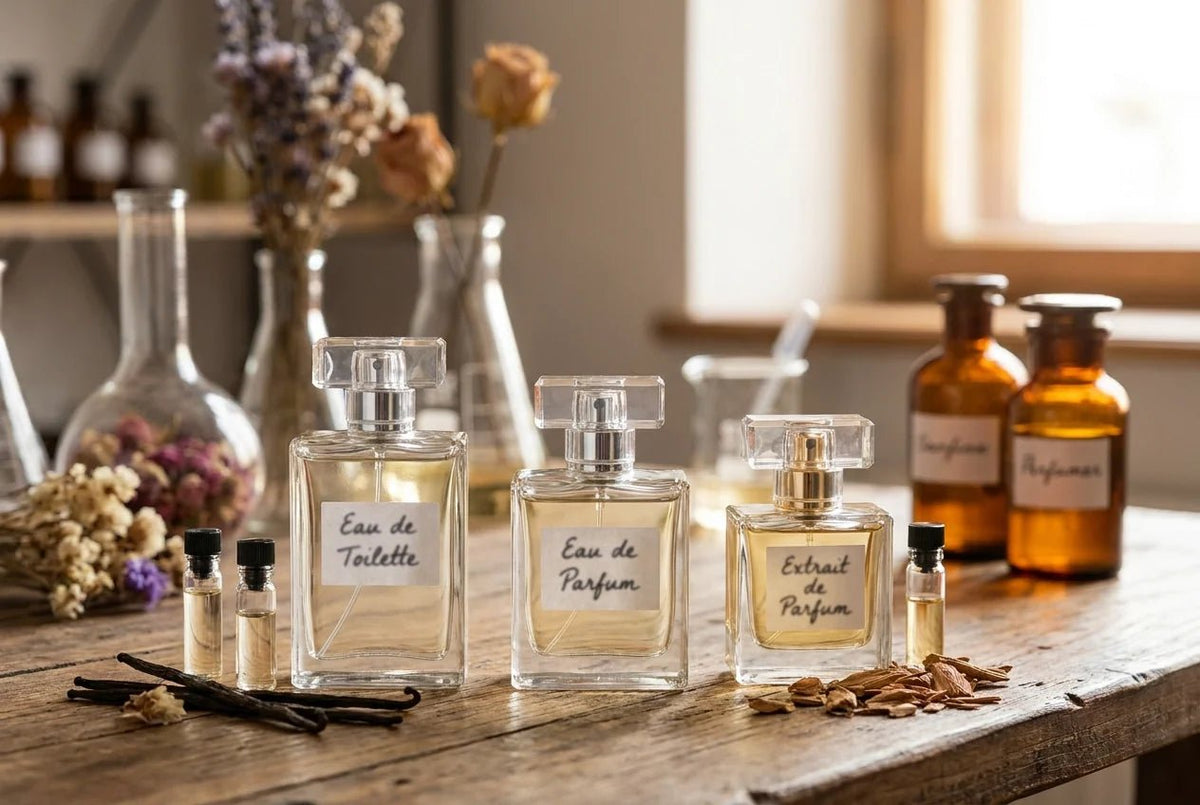
Ever sprayed an expensive perfume in the morning, only to find it has vanished by lunch? You are not alone. Most of us assume a higher price tag guarantees a scent that sticks around, but that is rarely the whole story.
The truth is that how long a fragrance lasts has very little to do with what you paid and everything to do with what is inside the bottle. Understanding the difference between EDT, EDP and Extrait is the secret to finding a long lasting affordable perfume that actually performs. It is simply a matter of concentration, not cost.
In this post, we will walk through the concentration ladder together. We will compare Eau de Toilette, Eau de Parfum and Extrait side by side, discuss where colognes fit in, and look at how fixatives and base notes affect wear time. We will also explore why your skin chemistry changes everything and how to judge any bottle before you buy. By the end, you will have a simple framework to choose scents based on performance, not marketing.
Why Price Is a Poor Predictor of Longevity
Most shoppers assume the pricier the bottle, the longer it lasts, and that anything cheap fades within the hour.
In reality, wear time comes down to three things: how much fragrance oil is in the bottle, the fixatives and base notes it is built on, and your own skin chemistry. Price is not on that list.
What you pay for is brand heritage, bottle design, packaging, influencer marketing and retail margin. Two bottles at very different price points can be built at the same oil load, which is how we make luxury affordable.
One caveat worth knowing: Eau de Toilette, Eau de Parfum and Extrait are market conventions, not legally defined categories. EU cosmetics labelling law governs ingredient disclosure on the bottle, not the concentration tier. The label is a strong hint, not a guarantee.
Know the ladder and you can judge any long lasting affordable perfume on the terms that matter, not the price tag or the logo on the cap. See why shoppers choose us.
The Concentration Ladder: EDT, EDP and Extrait Compared
So if price isn't the guide, what is? The concentration ladder. Treat it as rough industry ranges, not a rulebook. Two houses can both label a bottle Eau de Parfum and sit at opposite ends of the band.
Conventional bands:
Eau de Cologne: roughly 2 to 5 percent fragrance oil
Eau de Toilette: roughly 5 to 15 percent
Eau de Parfum: roughly 15 to 20 percent
Extrait de Parfum: roughly 20 to 40 percent
More oil and less alcohol means slower evaporation from skin, so a longer dry-down and more hours of wear.
Indicative windows: cologne around 1 to 2 hours, EDT 3 to 5 hours, EDP 6 to 8 hours, extrait from 8 hours and often into the next day on fabric.
Longevity is not projection. A high-concentration scent can sit close to the skin and stay quiet. A dilute citrus EDT can fill a room for an hour then vanish. Loud does not mean long lasting.
Practical takeaway: before you compare two bottles on price, compare the concentration printed above the name.
Eau de Toilette: Light, Bright and Shorter Wearing
As noted above, EDT sits at 5 to 15 percent fragrance oil and typically lasts 3 to 5 hours, so one re-spray before an evening out is usually enough. It is top-note dominant by design: you notice the opening most, and that bright phase evaporates fastest. Great for daytime, warm weather, offices with scent policies, students and commuters who want a clean, fresh signature that never overwhelms a lecture hall or train carriage. For budget shoppers, remember a well-built EDT with a solid wood or musk base can outlast a poorly built EDP that leans entirely on citrus and light florals. Concentration is a strong signal, not the whole story.
Eau de Parfum: The Everyday Sweet Spot
Where an EDT brightens and bows out, an EDP settles in and stays. As noted above, EDP sits at 15 to 20 percent fragrance oil and typically lasts 6 to 8 hours. That extra oil slows evaporation and gives the heart and base notes room to develop. By hour four, you are smelling something much closer to the scent you chose than you would with an EDT. It is often the best value point on the ladder: real staying power without the price jump that tends to come with an extrait. The trade-off? A rich EDP can feel heavy in high summer. Many people therefore keep a lighter EDT for hot days and a fuller EDP for cooler ones. Step up to extrait, however, and the maths changes again.
Extrait de Parfum: Maximum Concentration, Maximum Wear
If EDP is the everyday sweet spot, extrait sits at the very top of the ladder. As noted above, extrait runs from 20 to 40 percent fragrance oil, which is why it usually costs the most per millilitre, and typically lasts from 8 hours onward.
Here is the trick: you use far less. One or two dabs, or a single short spray, so a 50ml extrait can last a user as long in real terms as a 100ml EDT. That makes cost per wear the fairer measure. A pricier extrait used sparingly can work out cheaper per day than a cheap EDT you re-spray three times.
But extrait is not automatically the best choice. A heavy one can overwhelm a shared office, a warm climate or a first date. Context matters as much as longevity.
Where Eau de Cologne and Eau Fraiche Sit on the Ladder
Below extrait, the ladder keeps going. As noted above, eau de cologne sits around 2 to 5 percent fragrance oil, with eau fraiche lower still, so both act more like a splash-on refreshment than a fragrance you build a day around. Expect roughly 1 to 2 hours of wear, which is why they are sold as post-shower, post-gym or hot-afternoon products rather than signature scents.
This is your baseline. Seeing the ladder continue below EDT makes it obvious why a body mist or aftershave fades so quickly next to a proper EDP. Many body sprays and mists carry no concentration label at all, and these tiers are market conventions rather than legally defined categories, which is precisely why concentration matters more than the name on the front of the bottle.
What Else Makes a Scent Last: Fixatives and Base Notes
Concentration is the headline, but the base is the fine print. Fixatives slow the evaporation of volatile molecules, holding a scent on skin like a thickener holds a sauce together. The classics: resins like benzoin and labdanum, woods such as sandalwood and cedar, plus musks, amber, vanilla, tonka and patchouli.
That is why a 15 percent EDP built on resins, woods and musk can outlast a 20 percent extrait built on light citrus and airy florals.
The dry-down is the honest test. Base notes are where longevity lives, so a paper strip at thirty seconds tells you little. Judge it hours later, not seconds in. Heavier-base fans: our men's collection is worth a look.
Want the ingredients? IFRA's About Fragrance pages cover what fragrance is, how it is made and where it is sourced. The IFRA Transparency List publishes disclosed ingredients, the closest thing to seeing inside the bottle; IFRA's Standards Library shows a regulated, science-led category. See our identification and reference purposes note.
Skin Chemistry: Why the Same Scent Lasts Differently on You
Fixatives set the ceiling; your skin decides how close you get to it. Skin is not a passive surface. Oil content, moisture, temperature and pH all affect how quickly a fragrance evaporates from skin.
Dry skin releases fragrance fastest. Moisturising your spray points with an unscented lotion before applying is the single easiest way to add hours to any concentration.
Heat speeds everything up. Higher body temperature accelerates evaporation, which is why the same EDP lasts all day in a cold snap and feels gone by mid-afternoon in a hot climate.
Oil and pH change the smell itself. Acidic or oily skin can mute certain notes while amplifying others, so two people wearing the same bottle can smell genuinely different by hour three. External factors can shift the reading too.
So test on your own skin and live with it for a full day. A paper strip tells you what a fragrance smells like, never how long it lasts. Our delivery timeframes let you get a bottle in hand and run that test properly.
How to Judge Any Bottle for Longevity Before You Buy
Once you've tested on skin, the trick is knowing what to test. Before you spray anything, check the concentration line above the name. EDT, EDP or extrait tells you more than the rest of the label combined, and if a percentage is printed, use it.
Then read the base notes, as covered above: woods, resins, musks, amber, vanilla and patchouli signal staying power while citrus and light aquatics fade sooner. Our fragrance guides explain how to spot these.
Compare cost per millilitre and cost per wear, not sticker price. A 100ml EDP at £29.95 is roughly 30p per millilitre, the number worth comparing, not the brand on the box.
Ask for a sample or buy the smallest size first. Spray on skin and check at four and eight hours. That is the only test of your wear time.
Do this with affordable bottles too. Designer-inspired women's fragrances built at EDP level, 50ml from £24.95 and 100ml from £29.95, let you test the concentration-first approach without luxury prices.
Ignore the brand halo: two very differently priced bottles can carry the same oil load.
Application and Storage: Getting More Hours From Any Concentration
Spray onto pulse points and moisturised skin. Heat and moisture slow the release of fragrance, so the same bottle lasts longer on hydrated skin in cool weather. Don't rub your wrists together; friction and body heat crush top notes and speed evaporation. Spray clothing, a scarf or hair ends for a longer trail, but check it won't stain fabric first. Store bottles away from direct sunlight, radiators and bathroom humidity. Heat and light degrade a fragrance over months, so a degraded bottle reads as short-lived even at extrait strength. Keep the cap on and use within a sensible freshness window. An older, partly oxidised bottle can smell flatter and fade faster than a fresh one, which is storage, not concentration. If a bottle arrives less than fresh, our return eligibility page explains your options.
Conclusion: Your Concentration-First Decision Framework
Good storage and smart application squeeze extra hours out of any bottle, but they cannot change what is inside it. As covered above, longevity comes down to concentration, fixatives and skin chemistry, not price.
Four things to do before you buy:
Check the concentration first. EDT, EDP or extrait above the name is the single most useful detail on the bottle.
Read the base. As noted in the fixatives section, woods, resins, musks and amber signal staying power while citrus-forward formulas will always be brighter and shorter.
Moisturise pulse points and test on your own skin. Spend a full day with a sample before committing to a full bottle.
Judge value by cost per wear. A 100ml EDP-strength designer-inspired scent from Aromaavenue at £29.95 can deliver more hours per pound than a dilute luxury bottle at four times the price.
The number above the name tells you more about how long a scent will last than the number on the tag ever will.


Leave a comment
This site is protected by hCaptcha and the hCaptcha Privacy Policy and Terms of Service apply.