

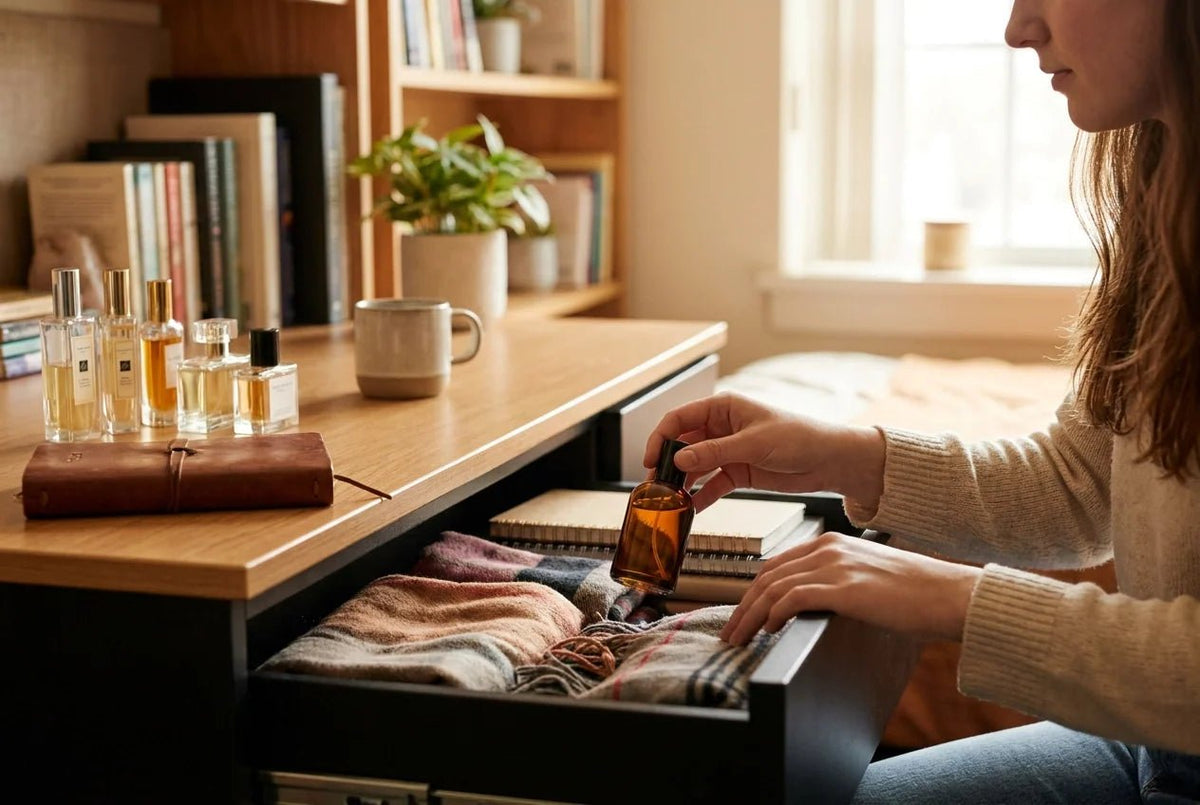
You bought a £25 perfume in freshers' week. By week six it smells like expensive regret. Here's the annoying part: the bottle probably hasn't gone off. Most budget fragrance disappointment comes from how you store and apply it, not from what it cost. This guide is about ownership: the everyday habits that keep a cheap bottle smelling good until term ends. We'll cover why a £25 bottle can smell cheap by week six, what you need before you start, and the rules that actually matter. Get it out of the bathroom. Protect it from light and heat. Moisturise first, spray second. Use pulse points, the right distance and no rubbing. Layer instead of spraying harder, build a student-budget layering pair, and run a term-length routine that works in halls, flats and shared bathrooms. We'll also drop common mistakes and myths. No collector's cabinet required. Just a few practical changes. The bottle is fine. The habits are the fix.
Why a £25 Bottle Smells Cheap by Week Six
The bottle you bought is not the variable. Your habits are. Two students can buy the same 50ml for £24.95 and get completely different results by week six. A 2025 evaporation study in the International Journal of Cosmetic Science, from researchers at URCOM, Université Le Havre Normandie, modelled how fragrance leaves skin. Evaporation depends on both the fragrance itself and the surface it lands on. The practical rules below are consumer guidance, not claims proven by that paper.
Three things actually change performance: storage degradation from heat, light and humidity; dry skin that lets molecules evaporate faster; and over-spraying instead of layering. Six sprays a day burns roughly 40-50ml in a single term, and the brighter top notes fade long before the bottle is empty. By contrast, 50ml at £24.95 comfortably covers a 10 to 12 week term at two to three sprays a day. That is why this routine is worth following. For more on how we keep luxury scents affordable, see How We Make Luxury Affordable. Find more student-friendly guides on our blog.
What You Actually Need Before You Start
The routine itself is cheap. Here is your kit list, and none of it is complicated.
A fragrance-free body lotion or moisturiser. This is the highest-return item here, and it costs less than a second bottle.
A dark, cool drawer, wardrobe shelf or box. Not a bathroom cabinet, not a windowsill, not a shelf above a radiator.
A 5ml to 10ml travel atomiser. Top up in a bag or at the library instead of re-spraying from the full bottle in a warm room.
One complementary scent or matching body lotion if you plan to layer. Two scents is plenty, so you do not need a collection. If you do want a second bottle, our Create Your Perfect Bundle keeps the cost down.
A small piece of tape or a marker. Note the date you opened the bottle so you can check it against the period-after-opening symbol on the label later.
Most of this you probably already own.
Storage Rule One: Get It Out of the Bathroom
Your drawer is ready. Now the bottle has to actually live there. Shared bathrooms and ensuite showers cycle through heat and humidity, and that is the classic environment for fragrance to degrade faster than it should. A 2010 review in the Journal of Cosmetic Dermatology found that higher temperatures accelerate the oxidative breakdown of fragrance components.
Keep the bottle in its original box if you still have it. The box blocks light, keeps dust off the glass and stops it rolling around in a bag.
In halls, decant 5ml to 10ml into an atomiser for the bathroom and leave the full bottle in your room. Never take the whole bottle down the corridor.
Never store near a radiator, on a windowsill or in a car glovebox in summer. A wardrobe shelf or desk drawer is the best spot in student accommodation.
Store upright with the cap screwed tight. Lying down invites leaks, and a loose cap lets air in and out with every temperature change. If your bottle arrives damaged, check return eligibility before term starts.
Storage Rule Two: Light, Heat and the Term-Length Timeline
Getting it out of the bathroom is half the job. The other half is what light and heat do over weeks.
UV light slowly breaks down fragrance compounds, so an opaque or boxed bottle kept in a dark drawer will out-perform the same juice left on a sunny windowsill. Heat speeds up evaporation and chemical change, which is why a cool wardrobe shelf beats a warm shelf, even when the warm shelf looks tidier.
Check the period-after-opening symbol on the label, often 24M or 36M, and treat it as a manufacturer guide. For the authoritative wording in the UK, check the OPSS cosmetic products guidance. A bottle opened in September and stored properly should still be perfectly usable in December. Term-length storage is realistic; bathroom storage is what shortens it.
Finally, do not decant the whole bottle into a clear plastic travel spray and leave it on a shelf for twelve weeks. Plastic and light are a poor combination. If you are topping up your supply, our delivery timeframes page tells you how quickly a replacement can reach you.
Application Rule One: Moisturise First, Spray Second
Now your bottle is stored properly, the next lever is your skin. Fragrance evaporates faster off a dry surface. A moisturised base gives scent molecules something to cling to, so the same two sprays read stronger and last longer.
Here is the routine. Straight after a shower, while skin is dry but still hydrated, smooth a fragrance-free or matching body lotion onto your pulse points. Wait a minute. Then spray. The order matters more than the products you choose.
Spraying cold, dry skin as you rush out the door is the usual mistake. You are giving the fragrance nothing to hold onto.
This is the cheapest longevity upgrade available. A few pounds of body lotion will do more for your £24.95 bottle than buying a second one.
If you layer, use a matching lotion. The base layer and the spray then agree instead of fighting, which is where a scent-family match pays off.
Application Rule Two: Pulse Points, Distance and the Rubbing Mistake
Once skin is moisturised, where you spray matters as much as when.
Target pulse points: wrists, inner elbows, base of the throat, behind the knees. These are warmer spots, so the scent keeps moving and stays readable.
Hold the bottle 10 to 15cm from your skin. Spraying closer dumps a concentrated patch in one spot, which floods your nose for ten minutes and then vanishes.
Never rub your wrists together. Rubbing crushes the top notes and drives the fragrance into your skin faster, shortening the whole wear curve.
Two to three sprays is the term-proof dose. Extra sprays do not extend wear; they spend the bottle and risk nose blindness, where you stop smelling it and assume it has gone.
Hair and clothes hold scent longer than skin, but use them sparingly. A light spray on a scarf is fine; a saturated collar can mark the fabric.
Get the dose right and you will not need to spray harder.
Layering Rule One: Layer, Don't Spray Harder
If two to three sprays is the dose, a fourth is never the answer. Spraying more repeats the same wear curve and empties your £24.95 bottle twice as fast. Layering builds a second structure underneath or on top of the first, so the scent has more to hold onto.
How to Build a Layering Pair
Start with something base-note driven, vanilla, amber or musk, then add a lighter, fresher scent over it. The heavier layer anchors the lighter one in place.
The cheapest version is the bridge layer: smooth an unscented or matching body lotion onto your pulse points, let it settle, then spray. Lotion is the longevity tool here, not more perfume. There is also review evidence on fragrance exposure supporting a lighter hand.
Two scents is the ceiling. Three or more muddles rather than deepens and burns through both bottles for nothing. Test any pairing on skin, never on a paper strip, and give it 20 to 30 minutes. Judgements made in the first two minutes are almost always wrong.
Layering Rule Two: Building a Student-Budget Layering Pair
If Rule One taught you to layer, Rule Two is about what to layer with. Start with one 50ml at £24.95 as your daily scent, then add a complementary 50ml for evenings out. Two bottles done well beat five done badly.
Match base notes, contrast top notes: citrus over vanilla, fresh floral over musk, woody over amber. If one scent is clearly your everyday wear, buy it in 100ml at £29.95 and keep the smaller bottle as your layering partner.
Store both identically in the same drawer so neither ages faster and ruins the pairing by week six. Decide which scent family you are missing before you spend, rather than buying impulsively. If you want to plan ahead, Create Your Perfect Bundle makes deliberate pairing easier, while checking new arrivals or your loyalty rewards helps you add the right second bottle without overspending. Both bottles then earn their place.
Your Term-Length Routine: Halls, Flats and Shared Bathrooms
Once your pairing is sorted, the routine is what keeps both bottles performing. Think of it as maintenance, not fuss.
Weekly: thirty seconds is enough. Check the cap is tight, the bottle is upright, and the drawer is still cool and dark.
Daily: moisturise your pulse points, apply two to three sprays, and carry a small atomiser for one top-up instead of a full re-spray.
Monthly: look at how much is left. If a 50ml bottle is emptying in a fortnight, your dose or your storage is the problem, not the product.
In a shared bathroom: never leave the bottle on the shelf. Decant, use, and take it back to your room. Flatmates knock things over, and showers create humidity that degrades fragrance faster.
End of term: cap it, store it upright and closed somewhere cool over the holidays. Do not leave it in a bag next to a radiator.
Follow this and the bottle you bought in September still smells like itself in December.
Common Mistakes and Myths Worth Dropping
Even with a solid term routine, a few stubborn myths still undo good habits. Drop these and your £25 bottle starts acting like it.
Myth: cheap perfume cannot last. Price is a weak predictor of performance. Storage, skin hydration and dose matter far more. The habits here separate a bottle that works from one that does not.
Myth: spraying more makes it last. It does not stretch the wear curve. It just empties the bottle faster and desensitises your own nose.
Myth: the fridge is good for perfume. Condensation, temperature swings and food odours all work against you. A dark drawer is better.
Myth: shaking mixes the scent. Fragrance is already blended. Shaking adds air and agitation for no gain.
Finally, do not judge longevity after ten minutes or on clothes alone. Give a scent half an hour on skin before deciding it has failed.
The Bottle Is Fine. The Habits Are the Fix.
So drop the myths, keep the habits. Three rules do the heavy lifting:
Store it out of the bathroom, somewhere dark and cool.
Apply it to moisturised skin, two to three sprays, no rubbing.
Layer instead of spraying harder.
Your one action today: move the bottle out of the bathroom and put a body lotion beside it. That single move changes more than any purchase.
The maths backs it up. A 50ml at £24.95, stored and applied properly, can genuinely cover a full term. A 100ml at £29.95 covers daily wear with room for layering. If you need a long-lasting, designer-inspired scent that fits this routine, Aromaavenue is the place to pick one up. No hard sell, just a bottle worth looking after. The bottle is not the problem. Treat it like equipment, not decoration, and it will last the term. That is the whole trick.
Conclusion
A £25 perfume can last a whole term when you treat it like equipment, not decoration. Keep storage simple: out of the bathroom, dark and cool. Apply to moisturised skin with two or three sprays, and do not rub. Layer instead of spraying harder, and ignore myths about shaking, fridges, and instant verdicts. Give scent half an hour on skin before judging it. Your one action today is easy: move the bottle and place a body lotion beside it. That single habit shift protects your scent and your budget. If you need a long-lasting, designer-inspired option for this routine, Aromaavenue has one. The bottle is fine. The habits are the fix, so start now.



Leave a comment
This site is protected by hCaptcha and the hCaptcha Privacy Policy and Terms of Service apply.